What Changes When a Race Runs Through the Night?
Night racing changes what drivers, teams, and spectators can read; understand the shift in visibility to follow the race beyond the obvious headlights.
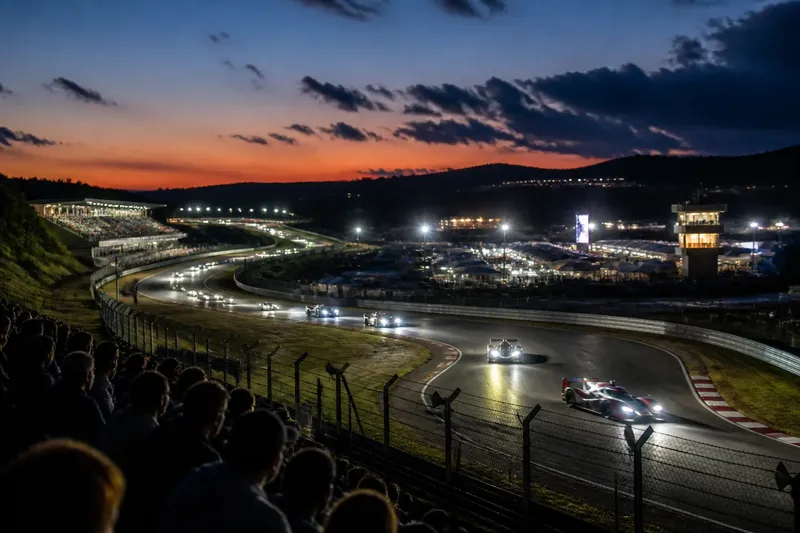
The common mistake in night racing is to treat darkness as a dimmer switch: the same race, only harder to see. That misses what changes first. A driver loses visual detail, a team loses some of its easy clues, and spectators begin reading the event through motion, sound, and light rather than a clear view of the whole track.
Before sunset
As daylight fades, familiar reference points change at different rates. A white curb may remain visible while a dark patch of rubber disappears; a marshal post can stand out against the track in daylight, then blend into the background. Drivers adjust not only to less light, but to a scene whose contrasts are being rearranged.
That transition can make the last daylight laps feel stranger than the first full night laps. The eye is still adapting, and the view varies from corner to corner according to sky, surroundings, and lighting. A driver approaching a shaded section may face a different visual problem from one crossing a brightly lit pit straight, even on the same lap.
Teams also watch for changing behavior rather than a simple drop in pace. A driver might leave a larger margin at a corner, make a less smooth correction, or describe a reference as difficult to pick out. Those details can help the crew distinguish a visibility issue from a change in traffic or grip, without pretending that the timing screen explains everything.
When night settles
Once darkness is established, headlights draw the eye toward what they illuminate, but they do not turn the circuit into daylight. The beam reveals a limited area ahead, while peripheral detail remains harder to read. A car can emerge from darkness quickly, and its position or direction may be less immediately obvious to someone watching from outside the cockpit.
For drivers, the visual task becomes more selective. They rely on consistent cues: the shape of a corner, the sequence of lights, the movement of another car, or a familiar braking reference. If one cue is obscured, the others matter more. This is why a small change in approach can be sensible even when the circuit itself has not changed.
For teams, the driver’s account becomes more valuable because some problems do not show up plainly on a screen. A report that a car was difficult to judge in a mirror, for example, describes a practical limit that lap data cannot fully convey. Radio exchanges may also become more specific, with drivers identifying where an object or car became visible rather than offering a vague verdict on the whole lap.
What viewers miss
From a grandstand, the race can look both faster and less legible. Headlights make approach and departure easy to notice, but they can flatten the apparent distance between cars. A group may seem close because several beams cross the same patch of track, even when the cars are spread out along the circuit.
Sound fills some of the visual gaps. Engine notes can announce a car before it enters view, while changes in pitch suggest acceleration or a shift in load. The cue is useful but imperfect: buildings, barriers, and the layout of the venue can make the source difficult to locate. Night spectators often hear an event before they can identify it.
Imagine a viewer standing near a bend where the exit runs behind a barrier. In daylight, they can follow cars through the corner and watch them recede; after dark, they may see the headlights turn, hear the engines rise, then lose the cars from sight. The expected result is a different kind of attention: tracking the rhythm of arrivals and departures rather than trying to maintain an uninterrupted view.
How does night change the race?
Why do cars look closer at night?
Headlights concentrate attention on a small part of the scene and can make separate cars appear to occupy the same visual space. Their beams reveal direction clearly, but provide fewer background cues for judging distance.
Can drivers see the whole circuit?
No. A driver sees a changing sequence of illuminated areas, ambient light, and shadow rather than the entire lap at once. The shape of the circuit and its lighting determine which references remain useful.
Why does the race feel quieter?
Darkness can reduce what spectators see at a distance, even while engine noise carries across the venue. When cars are out of view, the race may feel less continuous, with bursts of sound marking its progress.
Does darkness change strategy?
It can change how a driver describes traffic, references, and confidence through a section, which may inform team decisions. Darkness alone does not dictate a particular strategy; the race situation and the driver’s account still matter.
Through the long hours
As the night wears on, the spectacle can become less about a dramatic transition and more about repetition. The same lights pass the same point; small differences in their spacing or sound become easier to notice. A spectator who chooses one visible corner can begin to read traffic patterns without needing to see every part of the lap.
For a team, consistency in a driver’s descriptions can help separate a persistent visibility challenge from a temporary distraction. The point is not to turn each radio comment into a diagnosis. It is to notice whether the same place, kind of traffic, or visual cue keeps coming up.
When dawn returns
Dawn does not simply restore the daytime view. The scene changes again as ambient light returns, and familiar landmarks reappear at different rates. A driver who has spent hours working from illuminated cues must adjust to a broader view, while spectators may suddenly see the distance and setting that darkness concealed.
The most useful way to follow a night race is to notice what information each person can access. Drivers work from a narrow, moving field of view; teams combine timing with reports from the cockpit; spectators piece together fragments of light and sound. Night racing rewards that kind of attention more than the effort to see everything. The headlights are only the most obvious part of the story.
What is not worth the effort is trying to infer a driver’s exact line from a distant beam alone. A headlight can show where a car is pointing, not every correction or surface detail that shaped its path. The main search phrase, night racing, makes more sense when treated as a change in available information than as a visual effect: the race continues, but its evidence arrives differently.