One Driver or Several? Reading the Logic of a Shared Seat
Compare solo and shared-seat endurance racing by following the driver’s role, team handoffs, and the information that carries from one stint to the next.
The common mistake in comparing solo and shared-seat endurance racing is to count drivers and stop there. That misses the real cost: a solo driver carries every change in pace and circumstance personally, while a shared seat makes the race depend on handoffs, timing, and how well several people use the same car. To read either format, follow the driver’s role across the event rather than treating the entry list as the whole story.
Start with the format
First establish what the rules permit. A solo format assigns the driving to one person for the event, subject to applicable limits and procedures. In a shared-seat format, several drivers take turns in one car. Driver count alone does not tell you how long an individual stint lasts or how the team divides its work.
That distinction changes what “the driver” means. In a solo race, it is one person’s continuing relationship with the car and the changing race. In a shared-seat race, the phrase usually means the current driver, even though the entry’s result belongs to the group and the team operation around it.
Before drawing conclusions, check the event’s class, driver rules, and timing documents. A race may set limits on driving time or require particular driver categories; those details can change the practical shape of a shared seat. The event regulations and organizer’s instructions are the relevant sources for the specific race.
Follow the solo role
In a solo format, the driver remains the point of continuity. They encounter changes in traffic, track grip, weather, and car behavior directly, then adjust their decisions as the event develops. There is no teammate arriving with a different reference for the brake pedal or a fresh account of how the car feels.
Continuity can make subtle changes easier to interpret. If the car begins to feel less settled through a familiar corner, one person has earlier sensations in memory and can compare them with the present. That does not make diagnosis simple: fatigue, traffic, setup, and changing conditions may overlap, and the driver still has to decide what matters while racing.
The trade-off is that the same person carries the event’s accumulated workload. A solo driver cannot hand the car over to a teammate, so the role includes managing attention and effort over the full assignment, within the rules and support available. This is a format distinction, not a prescription for how anyone should train or pace themselves.
Imagine a solo entrant whose car develops a mild vibration after a stretch of traffic. Because the same driver felt the car earlier, they can compare the sensation with their own previous laps, report it to the crew, and avoid treating one impression as a complete diagnosis. The useful result is a clearer account for the team, not certainty about the cause.
Trace the shared seat
In a shared format, driving is divided into stints, and each stint is one part of a driver’s contribution. The person in the car has immediate responsibility for operating it and communicating observations. The teammates’ turns matter too: each handoff brings another person’s inputs and impressions into the same event.
That makes the seat a common interface. A driver may encounter a brake pedal, steering response, seat position, and controls adjusted for someone else’s preferences. The team must decide which settings stay consistent and which can be adapted without creating confusion. The car is not a private workspace, however much the seat may suggest otherwise.
Communication carries information across the gap between stints. A useful report describes an observable change: where it occurs, whether it is persistent, and how it differs from the driver’s earlier experience. “The rear moved on corner exit in traffic” gives the crew something to consider; “the car feels bad” offers less to work with. The next driver’s feedback can then be compared with the same reference points.
Say a shared-seat team hears one driver report understeer in a particular turn, while another says the car is reluctant to rotate there. Those descriptions may point toward a common handling issue, or they may reflect different approaches to the turn. The team can compare the reports with timing and other observations before deciding whether to change the car. The point is to preserve useful detail, not to declare one driver right.
Read the handoff
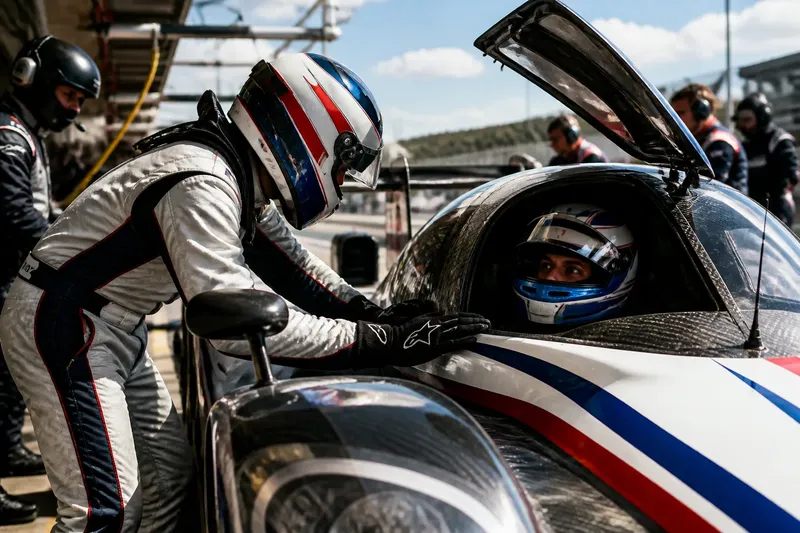
The driver change is where the shared format becomes visible to a spectator. It is not simply a pause between two people’s turns. The team must bring the next driver into the car, transfer relevant information, and resume the race within the event’s procedures. How the handoff is organized can affect the team’s use of available time, but the details differ by event and pit rules.
Watch for what passes from one driver to the next. A brief verbal note might cover traffic, a change in car behavior, or a control that needs attention. The incoming driver also needs a usable picture of the race: where nearby competitors are and what the crew expects from the next stint. A handoff transfers context, not just the steering wheel.
The exchange also reveals the team’s division of labor. One crew member may help the outgoing driver, another may prepare the incoming driver, and someone else may handle timing or communication. Those tasks are team operations rather than extra driving roles, but they shape how smoothly the next stint begins. A shared seat therefore spreads responsibility beyond the people whose names appear as drivers.
Solo races have no driver-to-driver handoff, but they still involve exchanges between the driver and crew. The difference is that continuity remains with the same person in the cockpit. The crew’s information has to meet that driver’s developing picture, rather than being carried forward by a teammate.
Judge the format
The format is best judged by tracking where continuity sits and how the team handles it. A solo driver carries continuity through the event; a shared team preserves it across people, stints, and conversations. The distinction also shapes what a spectator can reasonably infer from a driver change or an individual stint.
Questions about driver formats?
Why share a race car?
A shared seat lets several drivers contribute to one entry and divides the driving among them according to the rules and team plan. It also lets the team compare different observations of the same car, though those observations may not match neatly.
Can one driver race the whole event?
Some endurance formats permit a solo driver, while others require multiple drivers or impose limits that shape how a seat can be shared. The event’s regulations decide what is allowed; the word “endurance” alone does not settle the question.
Does a driver change always happen at a pit stop?
In many formats, teams arrange a change during a pit visit, but the exact procedure depends on the event rules and operational choices. A stop may combine the driver exchange with other work, so the visible change is only one part of the team’s plan.
Which format is easier to compare?
Neither format offers a simple comparison between drivers. A solo driver’s performance is shaped by one continuous assignment, while a shared entry reflects multiple stints, changing circumstances, and the team’s handling of information between them.
Compare the evidence
When judging an entry, keep the unit of comparison clear. A lap belongs to the person driving it, but the race result belongs to the entrant under the event’s rules. In a shared-seat race, one driver’s pace cannot stand in for every teammate’s contribution; in a solo race, a single name does not explain the crew’s work or the car’s condition.
Listen for the difference between a driver’s report and a team decision. A driver can describe what the car did; the crew may combine that account with timing, inspection, and information from other stints before changing anything. Avoid reading a setup change as a verdict on one driver. Teams adjust for the whole entry, and a change may reflect several considerations.
It is not worth trying to infer the entire strategy from a driver list or one stop. Those clues show the format and a moment in the team’s operation, not the reasoning behind every choice. A more reliable reading follows the sequence: who is in the car, what they report, what the team passes along, and how the next driver encounters the same machine.
Keep the seat in view
The useful distinction between solo and shared-seat racing is not simply endurance by one person versus endurance by a group. It is where continuity lives. A solo driver carries it through the event; a shared team has to preserve it across people, stints, and conversations.
That is the practical lens for reading the format. Follow the role in the cockpit, notice what information crosses each boundary, and separate an individual’s driving from the entry’s collective result. Once the shared seat is understood as both a driving arrangement and a handoff of context, the race becomes easier to read without mistaking one driver’s stint for the whole story.