The Rise of the Closed-Cockpit Prototype
See how the closed-cockpit prototype balances driver enclosure, visibility, airflow and access, and why its roofed silhouette became an endurance-racing hallmark.
The common mistake is to treat a closed-cockpit prototype as an open car with a roof added later. That reduces a set of linked design choices to one piece of bodywork: enclosure can change sightlines, access, weather protection and the way air meets the car, with different consequences for each design. The closed-cockpit prototype became an endurance-racing emblem not through one universal technical advantage, but through a form that joined driver space and body into a recognizable whole.
There was no single transition from exposed cockpit to sealed canopy. Designers worked within the rules and priorities of their periods, balancing protection, visibility, airflow, ventilation and entry. Those priorities varied, so the shapes that emerged were not interchangeable solutions to the same problem.
The open starting point
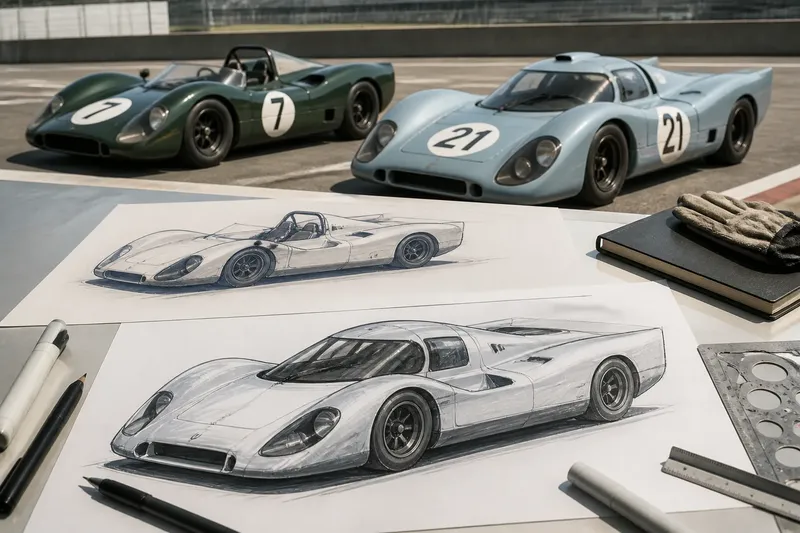
Many early sports prototypes drew on the roadster tradition. The driver sat in an exposed cockpit, with bodywork arranged around the seat and mechanical package rather than over the occupant. The layout made the driver visible and gave the car a low, open profile.
An open cockpit could simplify entry and make the seating area accessible to the crew. Its practical effects still depended on the car’s layout and the rules that applied to it; an exposed opening did not make every task straightforward.
With no roof or side glazing around the driver, weather and debris reached the cockpit more directly. Air also met an opening in the body rather than a continuous upper surface. How much that mattered depended on the design and conditions, so it is better understood as a compromise than as a fixed disadvantage.
The open prototype remains a distinct design choice, not a primitive stage destined to disappear. It foregrounds the driver and preserves roadster proportions, unlike the enclosed forms that became prominent in endurance-racing imagery.
The coupe takes shape
Closing the cockpit allowed designers to connect the nose, roof and rear body into a more continuous form. A roof could help manage airflow over the body and shield the driver from weather, but neither effect was automatic: the full shape, openings and operating conditions mattered. A canopy also created demands around sightlines, ventilation, entry and exit.
Prototype coupes took different forms. Some had doors, a roofline and rear glazing that suggested a compact road car; others integrated the cabin more distinctly into a purpose-built body. In either case, the cockpit became part of the car’s outer volume rather than an open interruption in it.
The visual change was clear even when its engineering effects varied. A roof established an upper contour, while the windscreen and side windows framed the driver within the body. How enclosed that space felt depended on the glazing, openings and proportions; not every coupe made the driver appear sealed inside a single shell.
The coupe suits a design brief centered on an enclosed driver and a roofed body. It can produce the familiar prototype outline of a low nose, compact cabin and long rear section, while requiring careful choices about glazing, access and the driver’s working environment.
The canopy as identity
As closed prototypes developed, the canopy became more than a cover. Windscreen angle, roof height, side-window shape and the transition into the rear body all contributed to the car’s appearance. Their effects varied by design: one combination could look blunt and purposeful, another sleek or delicate.
Endurance racing gave that visual language a durable setting. A roofed cockpit made the body read as a connected object from the grandstand or in a photograph, though the driver remained visible to varying degrees. The outline could be recognizable before the details inside the cabin were.
Teams and manufacturers could also distinguish a car through the canopy’s proportions. A broad windscreen, tapered roof or distinctive side-window opening might separate its character from another car’s, even within the same broad category. Livery could run across a more continuous body surface, though its effect depended on the shape and placement of the glazing.
Say a fictional team has two concept drawings: one shows an open cockpit and low rear deck; the other shows a fixed roof, broad windscreen and tapered cabin flowing into the tail. If the brief is to make the car read as an enclosed machine from a distance, the second drawing offers a more continuous roofed outline and body surface for color. The tradeoff is that the design must also account for the driver’s view, ventilation and access; the visual effect alone says nothing about which car would perform better.
Choosing a cockpit form
The right approach depends on the design brief and the regulations that apply. These forms are not simply old and new; each makes different priorities visible.
- Open cockpit: If the brief calls for a visible driver and roadster-like character, an open layout supports that impression; if enclosure from weather is a priority, consider a roofed form instead.
- Fully enclosed coupe: If a continuous roofed body and a pronounced cabin are the goal, a coupe offers that visual direction; if broad access or an open profile matters more, compare an open layout.
- Integrated enclosed canopy: If the cockpit should feel shaped into a competition-specific body, an integrated canopy can support that impression; if the driver’s view or access is compromised in the proposed shape, revise the openings and proportions.
- Rules check: If the applicable regulations permit the proposed cockpit form and openings, continue to package and visibility decisions; if they do not, revise the concept to fit the rules before styling it further.
- Visibility review: If the intended sightlines remain clear in the proposed windscreen and side glazing, retain the layout for further review; if important views are obstructed, alter the glazing or reconsider the cabin shape.
- Access review: If the driver and crew can use the proposed entry points, keep the arrangement for the next design stage; if access is awkward, revisit the door, opening or cockpit layout.
For a real competition car, the relevant regulations and technical requirements take precedence over broad historical categories. A designer should check the rules for the specific class rather than infer permission from a car’s resemblance to another prototype.
Closed-cockpit prototype questions?
Why did prototypes gain roofs?
A roof could enclose the driver and connect more of the body into a continuous outer shape. It also introduced tradeoffs in visibility, ventilation and access, and its effect on airflow depended on the design rather than on enclosure alone.
Are closed prototypes the same as sports cars?
No. A prototype is purpose-built for competition, while “sports car” can refer to a road-going type or a racing category defined by its own rules. A prototype may resemble a road car without being one.
What makes a canopy recognizable?
The relationship among windscreen, roof, side glazing and rear body gives the cabin its visual character. The shape of those surfaces matters alongside their transparency, and their proportions vary from car to car.
Did the open cockpit vanish?
No. Open and closed layouts have both appeared in prototype racing, with permitted forms depending on the category and its regulations. The enclosed cockpit became a strong visual shorthand, not the only possible design.
What is not worth chasing
It is not worth treating every roofline as evidence of a technical revolution. Regulation, packaging and styling can all shape a canopy, while small revisions may leave the basic layout unchanged. Without a specific car or design brief, assigning a grand story to every windscreen angle is mostly a way to keep looking at windscreen angles.
The closed-cockpit prototype is best understood as a convergence of enclosure, body design and visual identity, with the balance varying across cars and periods. When considering a particular closed-cockpit prototype, look at the roof and glazing alongside the openings and cockpit layout: those details show how the design addressed visibility, weather, airflow and access without assuming that every enclosed car solved them in the same way.